Most facility managers in Perth assume a clean-looking space is a safe space. That assumption can be costly. Deep cleaning is not about appearances — it is a structured, evidence-based process designed to eliminate pathogens, meet regulatory obligations, and protect everyone who walks through your doors. Whether you manage a gym, law office, medical clinic, or warehouse, the gap between routine cleaning and genuine deep cleaning is wider than most realise. This guide breaks down exactly what deep cleaning involves, how it differs across facility types, which tools and products deliver real results, and how to verify that the work has actually been done properly.
Key Takeaways
| Point | Details |
|---|---|
| Proven deep cleaning process | Deep cleaning follows sequenced steps with mechanical tools, specialised disinfectants, and verification for true hygiene. |
| Facility-specific strategies | Gyms, law offices, clinics, and warehouses each require tailored deep cleaning techniques suitable to their environment. |
| Verification matters | ATP testing is critical for confirming effective deep cleaning, not just relying on visual checks. |
| Compliance with Australian standards | Using TGA-registered disinfectants and documented procedures is essential for regulatory approval. |
What deep cleaning really involves
With the misconception out of the way, let’s look at what deep cleaning genuinely entails.
Deep cleaning is not simply scrubbing harder or spending more time on a mop. It is a systematic, sequenced process that follows defined steps to ensure hygiene is achieved at a microbial level, not just a visual one. Each step builds on the last, and skipping any one of them undermines the entire effort.
The sequenced deep cleaning methodology recognised by Food Standards Australia includes pre-cleaning to remove loose debris, washing with hot water and detergent, thorough rinsing, sanitising with TGA-registered disinfectants, and ATP testing to confirm results. Mechanical agitation, such as scrubbing and brushing, is essential because it physically dislodges biofilm and embedded grime that chemical solutions alone cannot reach.
Dwell time is another critical factor. TGA-registered disinfectants require specific contact times to achieve their rated efficacy. Wiping a surface immediately after applying disinfectant is a common mistake that renders the product largely ineffective. Your cleaning team needs to follow the manufacturer’s specified dwell time, every single time.
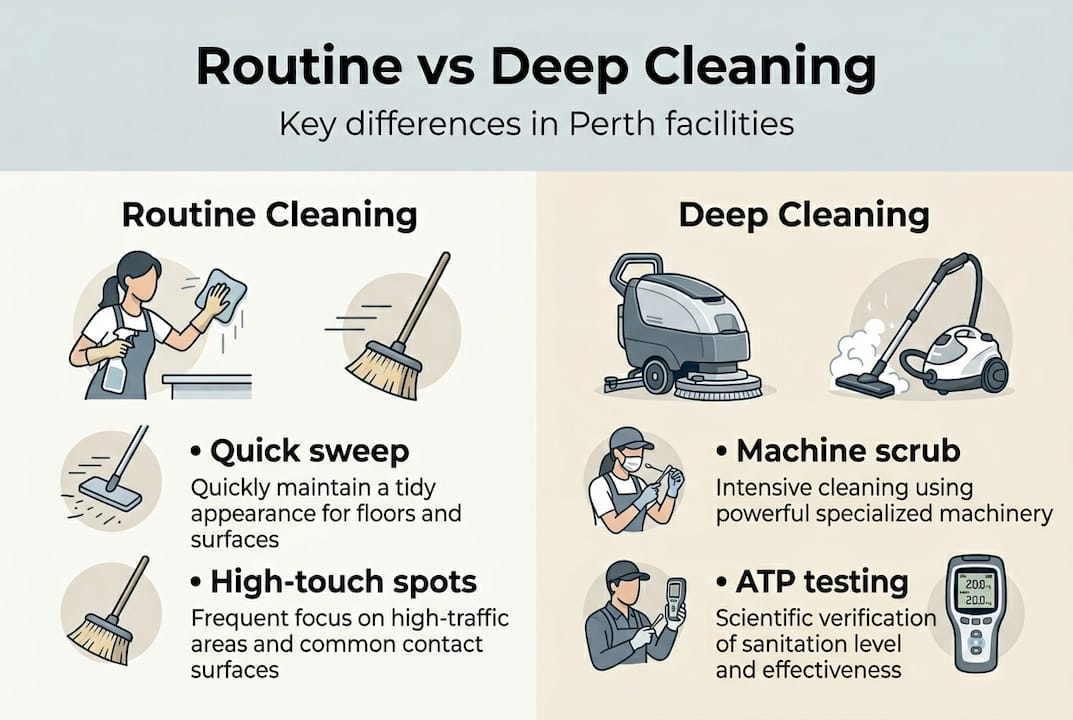
Here is a clear comparison between routine cleaning and deep cleaning:
| Feature | Routine cleaning | Deep cleaning |
|---|---|---|
| Frequency | Daily or weekly | Quarterly, monthly, or as needed |
| Focus | Visible surfaces | All surfaces, including hidden areas |
| Tools used | Mops, cloths, basic sprays | Auto-scrubbers, HEPA vacuums, pressure washers |
| Disinfection | General-purpose products | TGA-registered disinfectants with dwell time |
| Verification | Visual check | ATP testing and checklists |
| Regulatory compliance | Basic | Full documentation and audit-ready |
For facilities with secure access or sensitive areas, understanding cleaning procedures in secure structures is especially important when planning a deep clean programme.
The numbered steps of a professional deep clean typically look like this:
- Pre-clean: Remove loose dirt, debris, and waste
- Wash: Apply hot water and appropriate detergent with mechanical agitation
- Rinse: Remove all detergent residue thoroughly
- Sanitise: Apply TGA-registered disinfectant at the correct dilution and dwell time
- Verify: Use ATP testing to confirm microbial reduction
- Document: Record results for compliance and audit purposes
Pro Tip: Visual inspection alone is not a reliable measure of hygiene. ATP testing gives you empirical, non-subjective evidence that surfaces have been properly sanitised. If your current cleaning provider cannot offer this, it is worth asking why.
For new builds or recently renovated spaces, a builders cleaning guide can help you understand what baseline deep cleaning looks like before a facility opens.
Specialised deep cleaning techniques for different Perth facilities
Now that the essentials are clear, discover how deep cleaning varies for your specific facility type.
Not every facility has the same risks or the same surfaces. A one-size-fits-all approach to deep cleaning simply does not work when you are comparing a medical clinic to a warehouse. Each environment demands a tailored strategy.
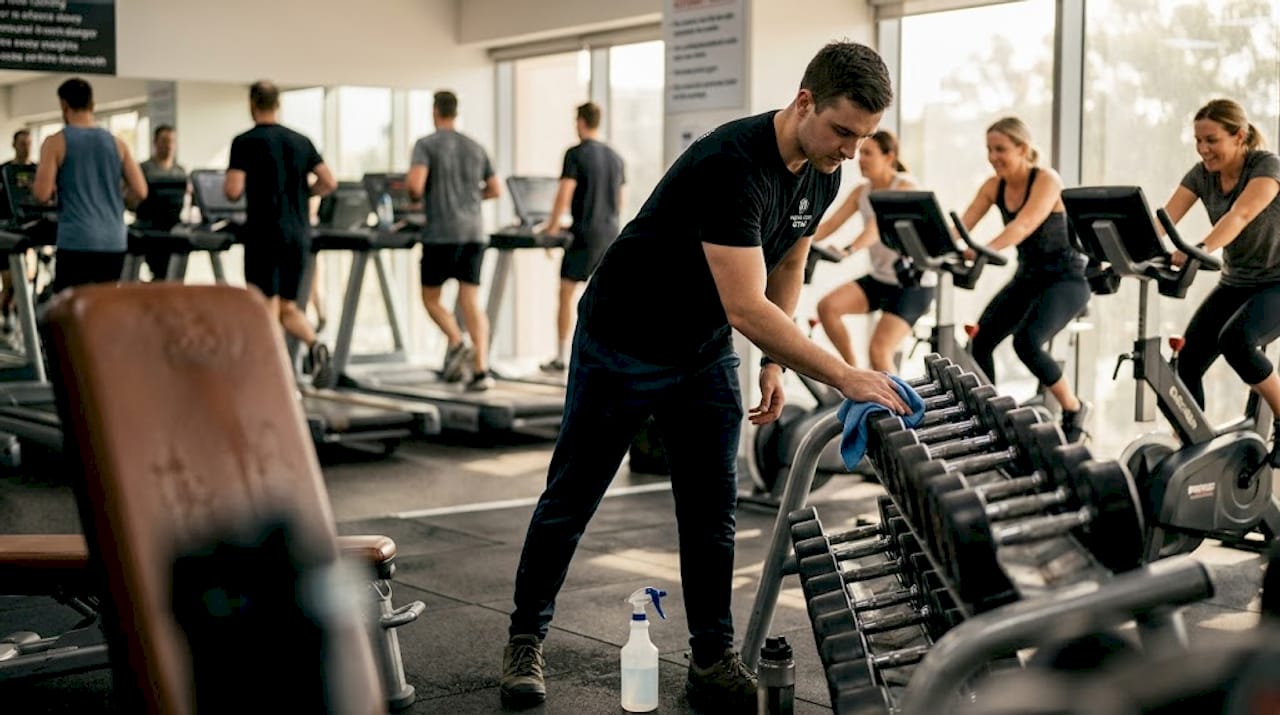
Gyms present unique challenges around sweat, skin contact, and high-traffic zones. Equipment surfaces such as weight benches, cardio machines, and resistance handles accumulate bacteria rapidly. Deep cleaning here focuses on sanitising all equipment contact points, treating rubber flooring with appropriate solutions, and targeting locker rooms and shower areas where moisture creates ideal conditions for mould and bacteria. Understanding gym equipment cleaning in detail helps you set realistic expectations for what a thorough service should cover.
Law offices may seem lower risk, but they accumulate significant dust, allergens, and bacteria on high-touch surfaces like keyboards, door handles, and shared meeting room furniture. Deep cleaning in offices involves dusting high and low surfaces, cleaning behind furniture, carpet extraction, and disinfecting all high-touch areas. The clean workplace benefits extend beyond hygiene, directly influencing staff productivity and client impressions.
Medical clinics operate under the strictest hygiene requirements of any facility type. Deep cleaning must align with infection control protocols, use hospital-grade TGA-registered disinfectants, and cover all clinical contact surfaces including examination tables, door handles, and waiting room chairs. Regulatory compliance is non-negotiable here.
Warehouses deal with grease, industrial dust, and machinery residue across large floor areas. Zone-based cleaning is the most practical approach, tackling loading docks, storage areas, and staff amenities separately with appropriate tools for each surface type.
| Facility type | Key deep cleaning tasks |
|---|---|
| Gym | Equipment sanitising, rubber flooring, locker rooms, showers |
| Law office | Carpet extraction, dust removal, high-touch disinfection |
| Medical clinic | Infection control protocols, clinical surface disinfection |
| Warehouse | Grease removal, floor scrubbing, zone-based cleans |
Pro Tip: Always check current regulatory requirements before scheduling a deep clean in a medical facility. Compliance obligations can change, and using non-approved products or methods can create serious liability.
Best tools and products for commercial deep cleaning
With facility-specific needs in mind, attention turns to the tools and products that deliver professional results.
The difference between a mediocre deep clean and an effective one often comes down to equipment. Manual methods have their place, but professional-grade mechanical tools are what separate surface-level cleaning from genuine hygiene outcomes.
“Mechanical agitation is essential for embedded grime.”
Mechanical tools like auto-scrubbers, pressure washers, and HEPA vacuums are integral to effective commercial deep cleaning. Auto-scrubbers simultaneously scrub and extract soiled water, making them ideal for large hard floor areas in warehouses and gyms. Pressure washers cut through grease and industrial residue that standard mopping cannot touch. HEPA vacuums capture fine particles and allergens that standard vacuums recirculate into the air.
On the chemical side, TGA-registered disinfectants are the only legally compliant option for commercial deep cleaning in Australia. The three most common active agents are:
- Chlorine-based solutions: Effective at 100ppm for general surface sanitising
- Alcohol-based solutions: 70% alcohol is highly effective for hard non-porous surfaces
- Heat: A 77°C soak for a minimum of 30 seconds achieves reliable microbial reduction
Each method has specific applications. Alcohol solutions work well on equipment surfaces in gyms and offices. Chlorine solutions are suited to food preparation areas and washrooms. Heat is used in commercial dishwashing and laundry processes.
A standard commercial deep cleaning equipment list includes:
- Auto-scrubbers for hard floors
- HEPA-filter vacuum cleaners
- Commercial pressure washers
- Steam cleaning machines
- Microfibre cloths and colour-coded systems to prevent cross-contamination
- Telescopic dusting tools for high surfaces
For facilities with sector-specific needs, understanding cleaning standards in sectors across Australia gives you a useful benchmark for what your facility should expect from a professional service.
How to verify deep cleaning outcomes
Even with the right methods and tools, verification is key to maintaining standards.
One of the most overlooked parts of deep cleaning is confirming it actually worked. A freshly mopped floor and a pleasant smell are not evidence of hygiene. They are evidence of cleaning activity. Verification requires a different approach entirely.
ATP testing provides empirical proof of cleaning efficacy and is far superior to visual inspection. ATP (adenosine triphosphate) testing uses a swab and a luminometer to detect biological residue on surfaces. A high ATP reading after cleaning indicates that sanitising was insufficient. A low reading confirms the process worked. Results are available within seconds, making it a practical tool for on-the-spot verification.
Visual inspection falls short because many pathogens are invisible to the naked eye. A surface can look spotless and still harbour dangerous levels of bacteria. Relying solely on visual checks creates a false sense of security that can have real consequences in regulated environments.
For post-construction cleaning verification, ATP testing is equally valuable in confirming that construction dust and residue have been fully removed before a facility opens.
Methods to validate deep cleaning outcomes include:
- ATP testing: Swab surfaces post-clean and measure biological residue
- Signed checklists: Cleaners document each task completed with time stamps
- Dwell time monitoring: Confirm disinfectants were applied for the required contact time
- Regulatory audits: Third-party inspections provide independent verification
- Photographic records: Before and after images support accountability
Pro Tip: Ask your cleaning provider to include ATP test results in their service report. This creates a documented hygiene record that is invaluable during regulatory audits or insurance reviews. Spring cleaning verification practices offer additional insight into building a consistent verification routine.
Why deep cleaning must evolve for Perth facilities
Having covered verification strategies, it is time for a candid look at where deep cleaning is headed.
Here is something most cleaning articles will not tell you: the biggest risk in facility management is not a visibly dirty space. It is a space that looks clean but is not. Visual tidiness creates a false sense of security that can persist for months before an audit, an illness outbreak, or a regulatory notice forces the issue.
Perth’s regulatory climate is tightening. Facilities across health, fitness, and legal sectors are being held to higher documentation standards. A cleaning log that simply says “cleaned” is no longer sufficient. Inspectors want dwell times, product names, ATP results, and staff sign-offs.
The facilities that handle this well are not the ones with the biggest cleaning budgets. They are the ones that have embraced evidence-based protocols and treat cleaning as a measurable outcome rather than a task to tick off. Upgrading to ATP testing and structured checklists may feel like extra work initially, but it pays off in compliance confidence and genuine hygiene outcomes.
For practical guidance on day-to-day upkeep between deep cleans, office maintenance tips provide a useful framework for keeping standards consistent.
The future of facility cleaning in Perth is documented, verified, and evidence-driven. The sooner your facility adopts that standard, the better positioned you will be.
Professional support for your deep cleaning needs
For managers eager to implement expert strategies, here is where to find professional help.
At Sparkle Commercial Cleaning, our well-trained cleaners bring extensive knowledge and state-of-the-art equipment to every job. We understand the specific demands of gyms, medical clinics, law offices, and warehouses across Perth, and we tailor every deep clean to your facility’s requirements.
Whether you need commercial cleaning in Belmont, specialised medical facility cleaning, or dedicated gym cleaning services in Perth, we have the expertise and equipment to deliver verified, compliant results. Contact us today to discuss a tailored deep cleaning programme for your facility. 🧹✅
Frequently asked questions
How often should deep cleaning be scheduled in Perth facilities?
Most facilities schedule deep cleaning quarterly or biannually, but high-risk environments such as gyms and medical clinics often require monthly cycles to meet hygiene and compliance standards.
What makes deep cleaning different from regular cleaning?
Deep cleaning uses mechanical tools, TGA-registered disinfectants with correct dwell times, and evidence-based verification like ATP testing, while regular cleaning focuses primarily on visible dirt and surface tidiness.
Is ATP testing necessary after deep cleaning?
Yes. ATP testing confirms that surfaces have been properly sanitised at a microbial level and provides documented proof that is far more reliable than a visual check alone.
Do disinfectant products need approval in Australia?
Yes. Only TGA-registered disinfectants are legally compliant for commercial deep cleaning in Australian facilities, and they must be used at the correct dilution and dwell time to be effective.
Recommended
- Builders Cleaning Perth: A Comprehensive Guide – Sparkle Cleaning Services Perth
- Commercial Cleaning Services Perth: A Comprehensive Guide – Sparkle Cleaning Services Perth
- Commercial Office Cleaning Company Perth Spring-Cleaning Tips – Sparkle Cleaning Services Perth
- Why Commercial Cleaning Perth Is Essential for Every Business in 2025 | Sparkle Commercial Cleaning